Green Infrastructure & Stormwater Management

Swales & Vegetated Drainage Systems

Engineered solutions supporting surface runoff conveyance, infiltration and integrated stormwater management within landscaped and urban environments

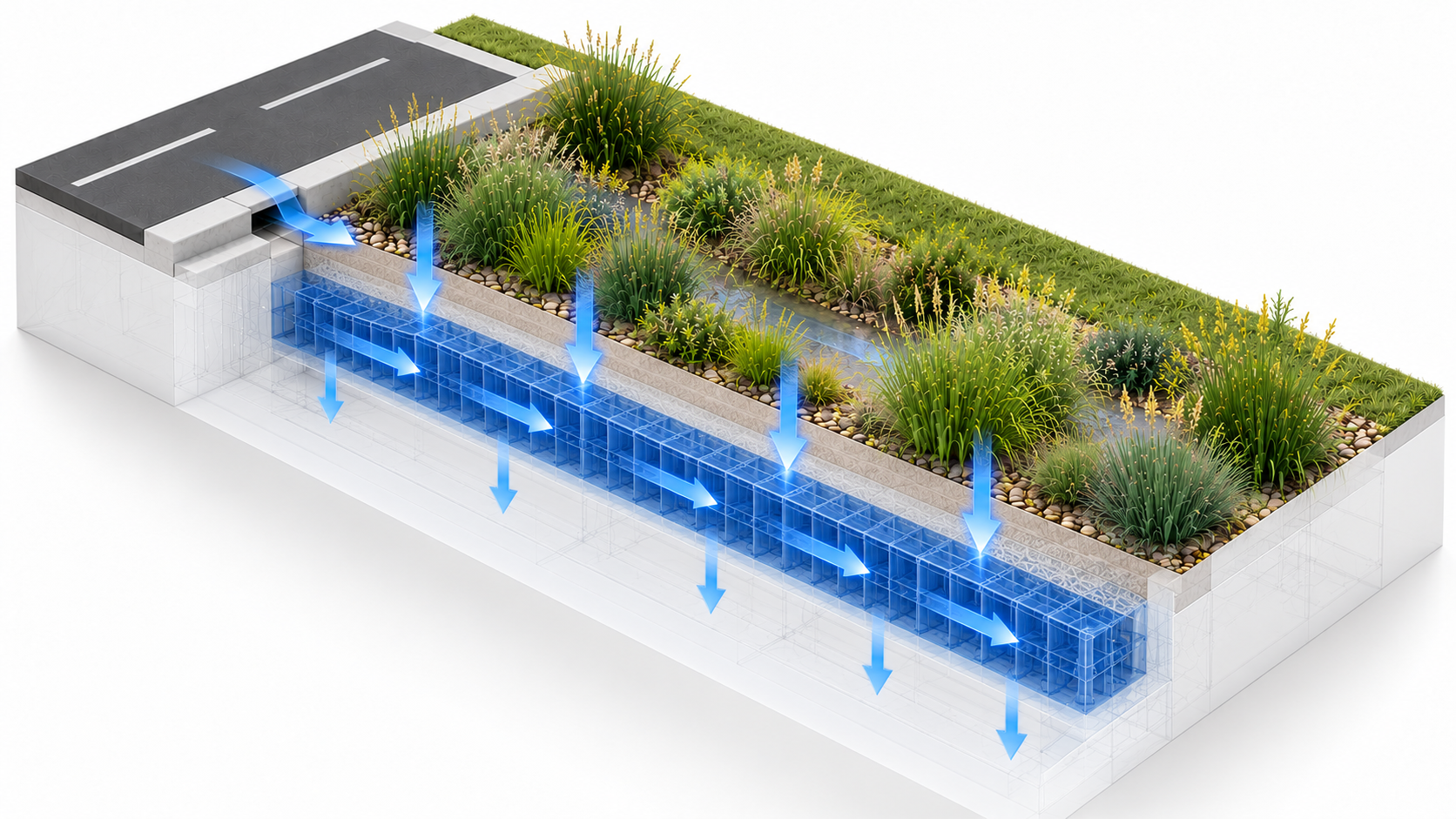
Swales are shallow, vegetated or landscaped channels designed to collect and convey surface runoff as part of an integrated stormwater management strategy. Depending on their configuration, they can also support infiltration, flow attenuation and the removal of certain stormwater pollutants through vegetation and engineered soil media.

The hydraulic performance of a swale depends on its geometry, longitudinal gradient, vegetation, soil permeability and the characteristics of the contributing catchment. Where site conditions require additional drainage or infiltration capacity, subsurface drainage and modular stormwater systems can be incorporated into the design to complement surface water management.

These systems can be integrated into urban streetscapes, road corridors, car parks and landscaped open spaces, supporting the development of functional and sustainable stormwater infrastructure.
System Principles

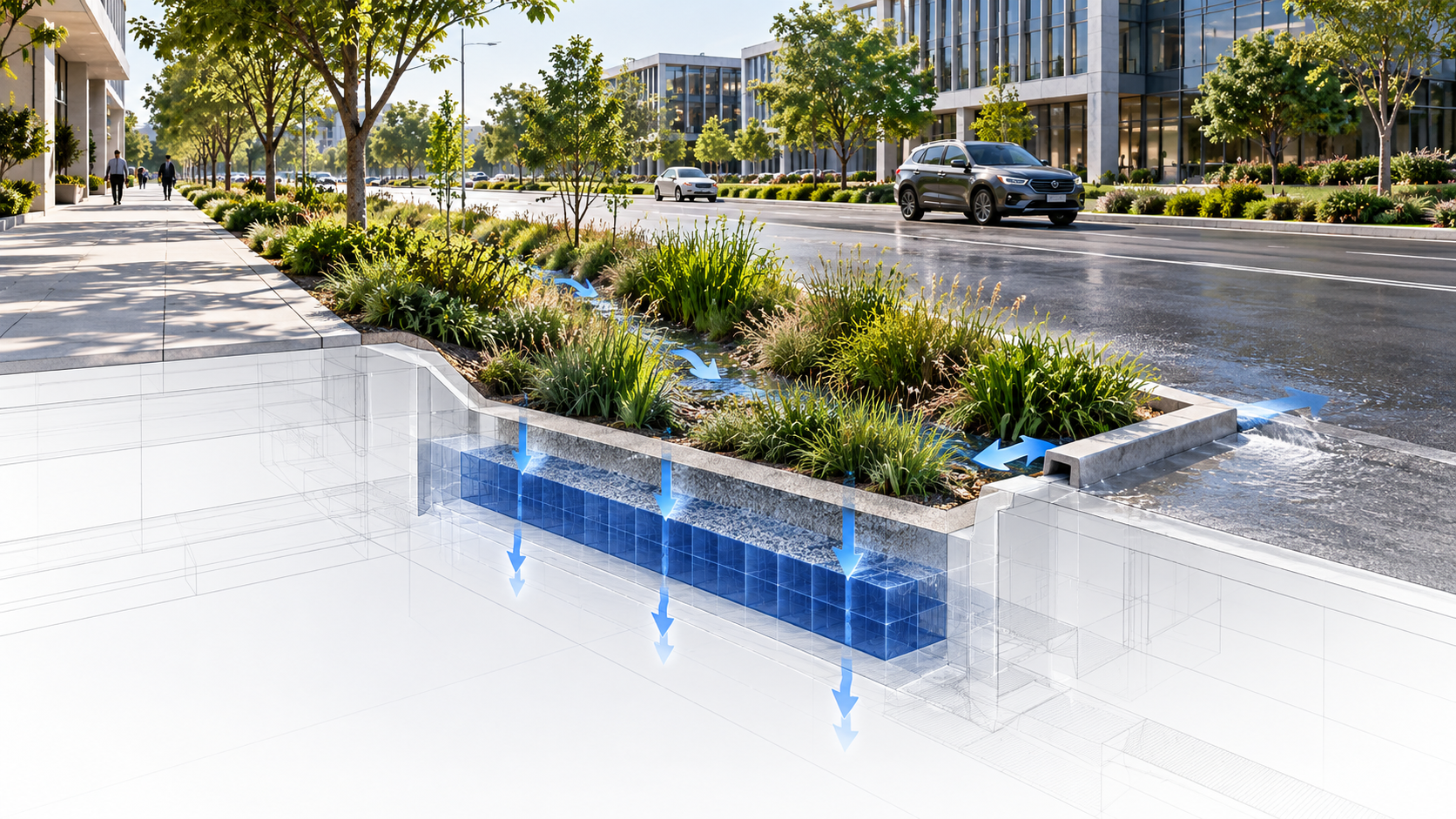
Vegetated swales manage stormwater through a combination of surface runoff collection, controlled conveyance, infiltration and, where required, subsurface drainage. Their performance depends on the interaction between channel geometry, vegetation, soil characteristics and the supporting drainage infrastructure.
Surface Runoff Collection

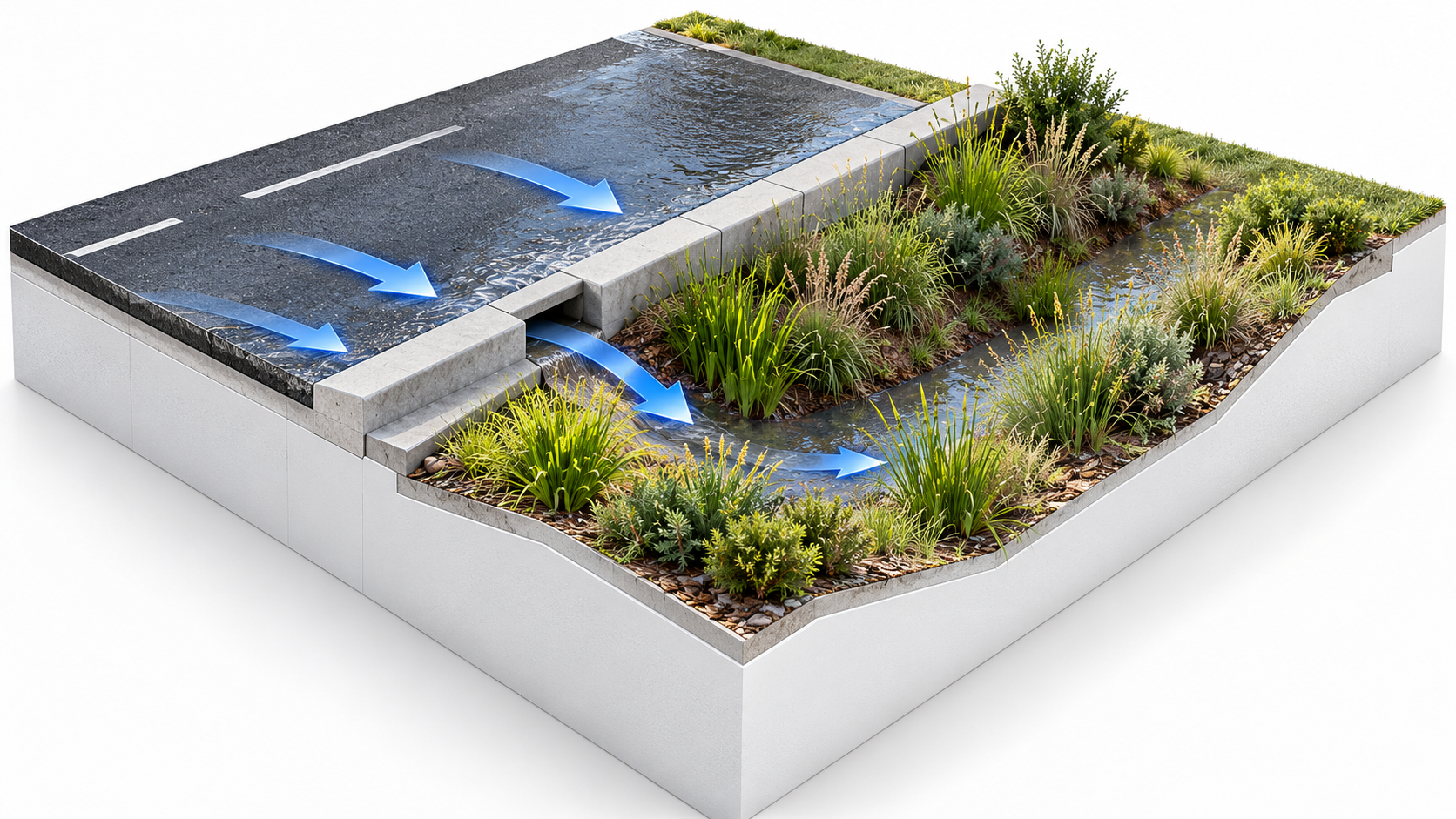
Swales receive surface runoff from adjacent roads, paved areas and landscaped catchments through appropriately designed surface gradients and inlet arrangements. Their shallow channel profile directs runoff into the vegetated drainage corridor, providing an initial point of collection within the stormwater management system.

Flow Conveyance & Attenuation

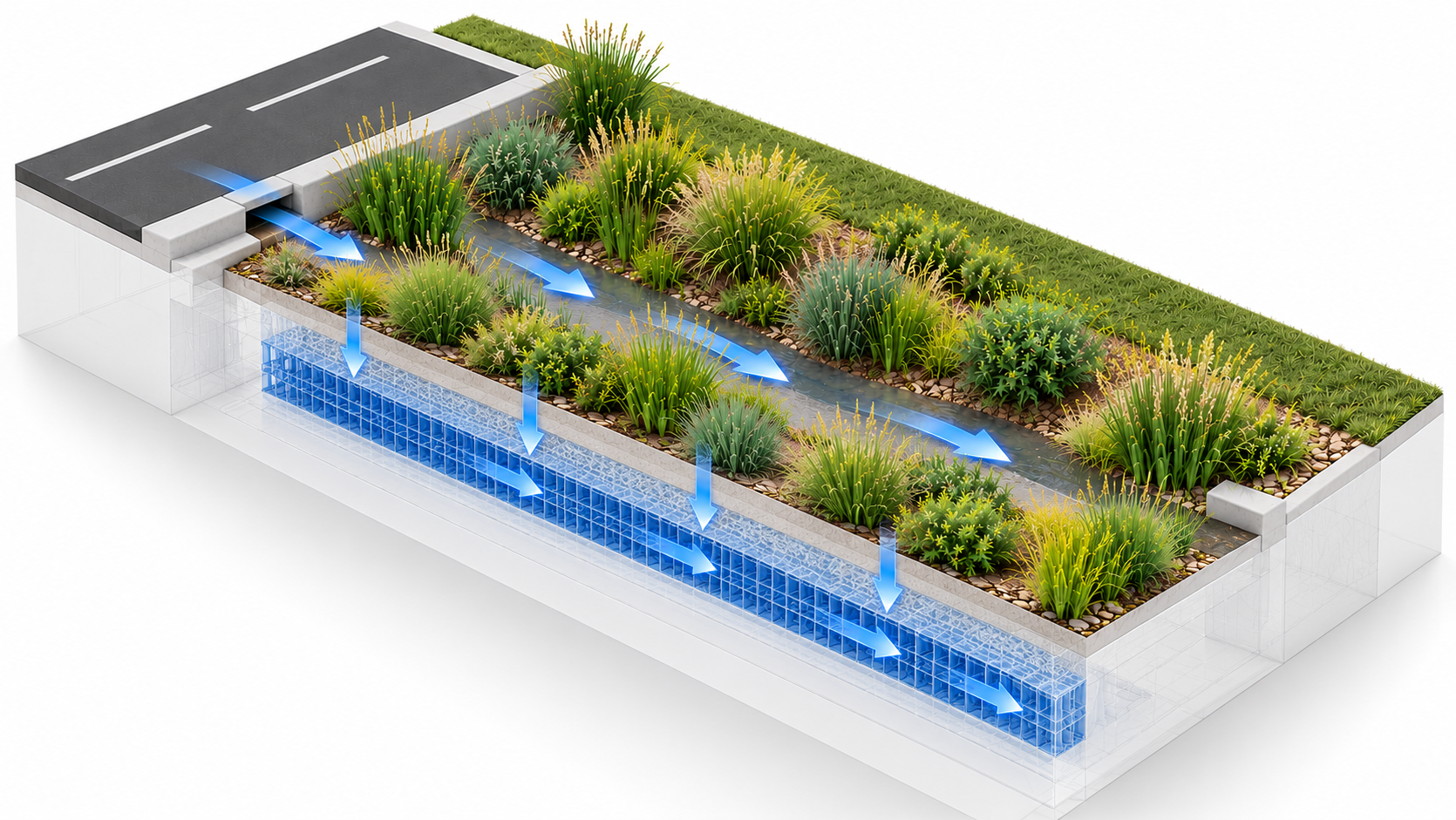
The longitudinal gradient and cross-sectional geometry of a swale guide surface runoff along the vegetated channel. Vegetation and surface roughness help moderate flow velocity and increase hydraulic residence time, allowing stormwater to progressively infiltrate through permeable surface layers. Where subsurface drainage is incorporated, infiltrated water can be collected and conveyed towards designated discharge points.

Subsurface Drainage & Infiltration

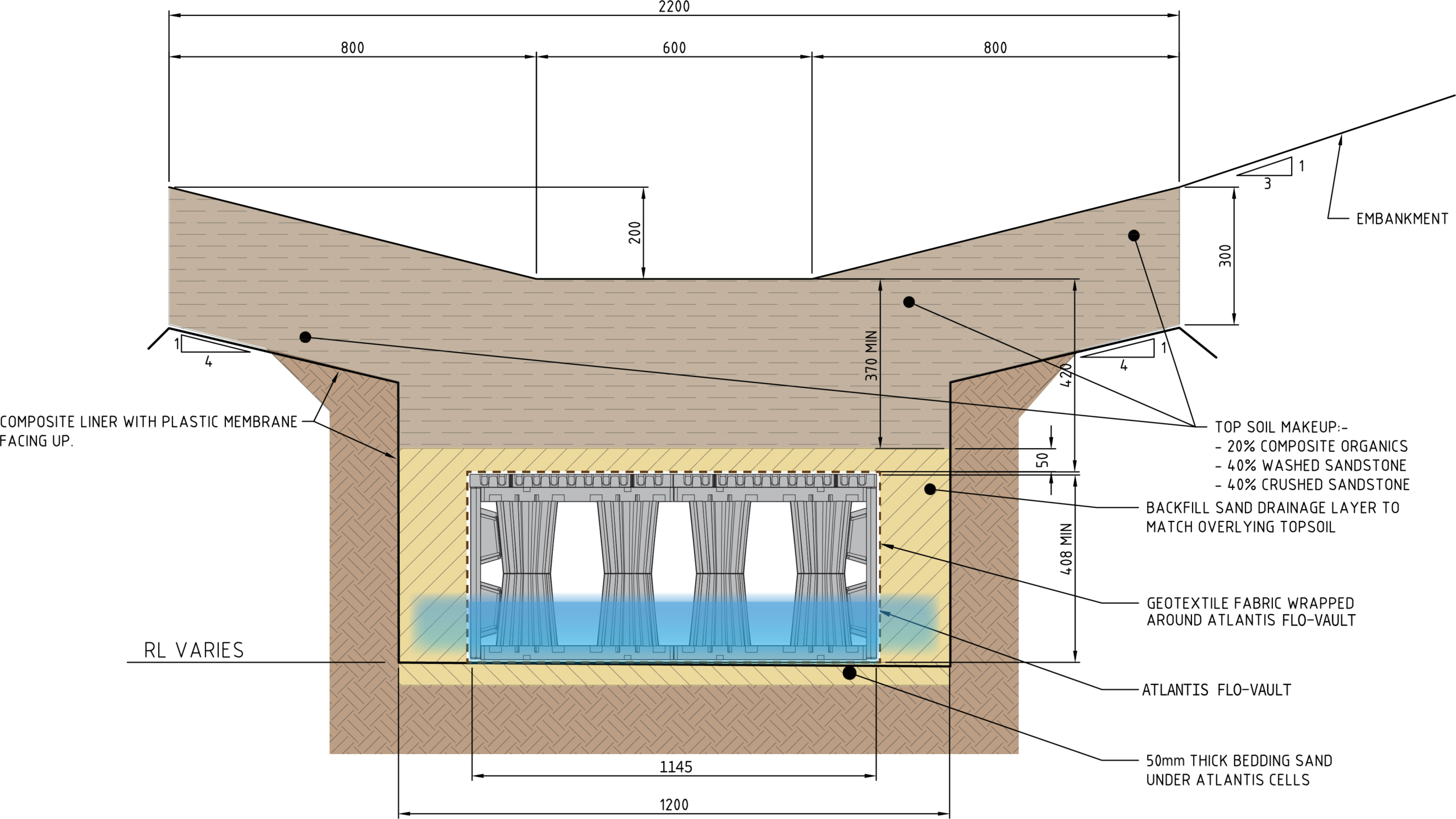
Stormwater infiltrates through the vegetated surface and underlying permeable media, where vegetation and soil can assist in retaining sediment and certain pollutants. Water reaching the subsurface Atlantis drainage system can be temporarily accommodated and conveyed towards a designated discharge point. Where ground conditions and system configuration permit, the drainage assembly can also facilitate infiltration into the surrounding soil while continuing to convey water downstream.

Key Design Parameters

The design of vegetated swales requires consideration of catchment characteristics, hydraulic performance, surface gradients, soil conditions and vegetation. Where subsurface drainage or infiltration systems are incorporated, their configuration must also account for water conveyance, discharge requirements and long-term maintenance. These parameters influence the integration and performance of swales within urban and landscaped stormwater infrastructure.
Catchment Area & Runoff Characteristics

The contributing catchment area, surface permeability, rainfall intensity and runoff characteristics determine the volume and rate of stormwater entering a swale. Design should consider anticipated inflow conditions, runoff distribution and the capacity of collection points to direct water into the vegetated drainage corridor.

Channel Geometry & Hydraulic Capacity

Swale width, depth, cross-sectional profile and side slopes influence surface flow capacity and the movement of stormwater through the vegetated channel. Design should consider anticipated flow depths, hydraulic capacity and available freeboard, while coordinating the channel geometry with the underlying subsurface drainage system and site-specific ground conditions.

Subsurface Storage & Drainage Capacity

The available void space and hydraulic characteristics of the subsurface drainage system influence its capacity to temporarily accommodate and convey stormwater beneath the vegetated swale. Design should consider anticipated inflow volumes, the configuration and continuity of the modular system, hydraulic gradients and downstream discharge capacity. The required system dimensions and arrangement should be determined according to project-specific hydraulic requirements.

Soil Permeability & Subgrade Conditions

Soil permeability, infiltration capacity, groundwater conditions and subgrade characteristics influence the feasibility of infiltration and the performance of the subsurface drainage system. Where infiltration into the surrounding ground is intended, design should consider site-specific soil conditions, groundwater separation and the compatibility of the proposed drainage configuration with adjacent structures and infrastructure.

Vegetation Selection & Surface Media

Vegetation type, root development, planting density and surface media influence hydraulic roughness, sediment retention and the long-term condition of the swale. Planting and soil media should be selected with consideration for local climate, anticipated inundation, drought tolerance, permeability and compatibility with the underlying drainage system.

System Configuration, Outlets & Maintenance

The integration of modular drainage systems beneath vegetated swales requires coordination of installation depth, surrounding materials, separation layers and available discharge points. Design should consider the intended drainage and infiltration strategy, outlet arrangements, sediment management and provisions for inspection and maintenance. System configuration should be verified against project-specific requirements and applicable engineering specifications.

OUR PRODUCTS

Select the System

Explore Atlantis modular stormwater systems for integration beneath vegetated swales. System selection depends on available installation depth, hydraulic requirements, subsurface storage and conveyance needs, and site-specific drainage and infiltration conditions.

Atlantis Flo-Channel system used for underground water storage and efficient stormwater drainage.

Flo-Channel®

Modular subsurface drainage system with a published flow rate of 28.5 L/s/m at a 1% gradient. Its 450 mm profile and 95% void ratio provide a potential solution for conveying stormwater beneath vegetated swales, subject to hydraulic design and installation requirements.

Flow rate

28.5 L/s/m at 1% gradient.

Height

450 mm

Void Ratio

95%

Atlantis Flo-Arch system used for efficient underground water storage and stormwater management.

Flo-Arch®

Arch-shaped modular drainage system with a published flow rate of 57 L/s/m at a 1% gradient. Its 816 mm width and 95% void ratio provide a wider subsurface flow configuration for swales requiring greater conveyance capacity, subject to project-specific hydraulic assessment.

Flow rate

57 L/s/m at 1% gradient.

Width

816 mm

Void Ratio

95%

Atlantis Flo-Tank modular system for underground stormwater management and infiltration.

Flo-Tank®

Modular geocellular system providing 119 litres of storage capacity per module and a 95% void ratio. Flo-Tank can be considered for subsurface stormwater storage beneath vegetated swales where temporary water retention and drainage are required, subject to the hydraulic design.

Flow rate

11.5 L/s/m at 1% gradient.

Height

450 mm

Void Ratio

95%

Flo-Vault used for underground stormwater management, increasing water storage and infiltration efficiency

Flo-Vault®

Modular polypropylene system providing 157 litres of net storage volume per module, a 95% void ratio and a published strength of 40 tonnes/m². Flo-Vault SD may be considered where subsurface stormwater storage and structural loading requirements must be addressed within an integrated swale design.

Flow rate

50 L/s/m at 1% gradient

Height

500 mm

Void Ratio

95%